



OUR EARLY YEARS PHILOSOPHY
Inquiry through play
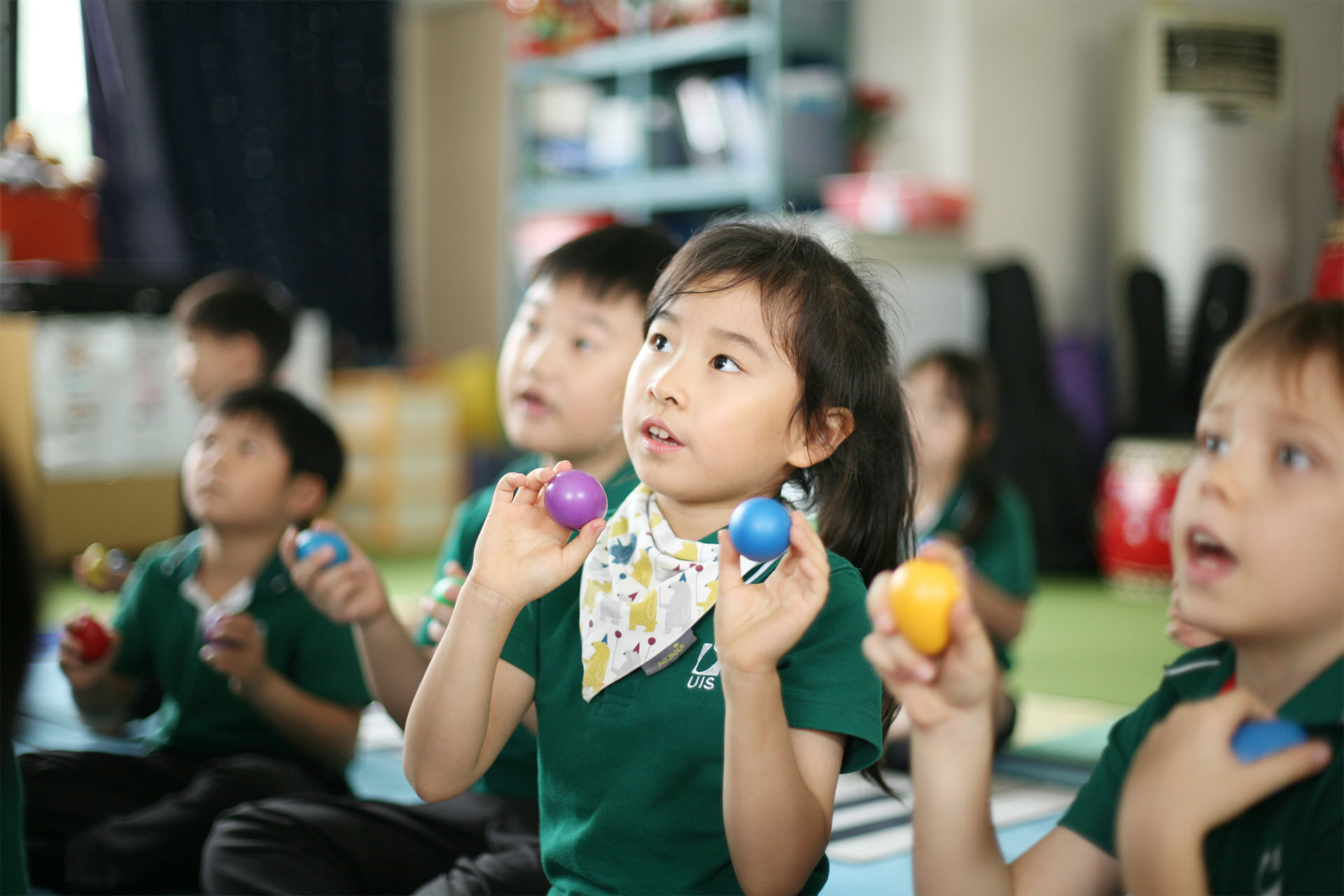
We embrace inquiry through play as the child’s primary expression of social-emotional, linguistic, cognitive and physical development.
We respect each young learner’s unique learning style, cultural background, interests and identity, and we aim to create a warm and inclusive family atmosphere where everyone feels inspired to work together in a genuine partnership in education.
WHY IB EARLY YEARS
Why families choose IB Early Years
Early Years is the first step of the IB Continuum, our main curriculum. Children join from age 2 and grow with the same inquiry-based approach all the way to the IB Diploma.
One pathway from age 2 to Grade 12
Children begin the IB Primary Years Programme in K and continue through the PYP, MYP and DP, with no change of school or curriculum along the way.
Recognized around the world
UISG is Guangzhou’s first IB World School. The PYP is taught in IB schools worldwide, so families who relocate can move easily between IB schools.
Mother Tongue in the school day
Mother Tongue classes are part of the Early Years timetable, so children keep growing in their home language alongside English and Chinese.
Specialist classes and the whole campus
Specialist classes, our swimming program and outdoor play give young learners a rich, balanced week on our lakeside campus.
Activities included
Teacher-led extracurricular activities (ECAs) are included for IB students, so families get more from the school day without extra fees.
Early coding and design thinking
Children code screen-free Tale-Bot Pro robots and take their first steps in design thinking, the start of our Technology, Innovation & Design pathway to the IB Diploma.
Already at the Utahloy Nursery Center? Children can move into IB Early Years from age 2.
TWO APPROACHES TO EARLY LEARNING
How IB Early Years and Montessori differ
Both programs see children as capable and curious. The difference is how inquiry happens, and how it leads into the rest of school.
Inquiry in the IB PYP Early Years
In the PYP, inquiry is the organizing framework for the whole program. It is usually collaborative and built around concepts.
- Learning is organized into transdisciplinary themes and units of inquiry. Early Years programs explore 4 of the 6 themes over the year.
- Play-based learning is the main approach. Children and teachers co-construct learning, and teachers act as co-inquirers.
- Key concepts such as form, function, causation and change, along with the learner profile and approaches to learning, shape the questions children pursue.
- Agency and student voice are explicit goals. Children help shape what gets explored and how.
- Assessment is ongoing, mostly through documentation of learning.
Inquiry in Montessori
Montessori is built on child-led discovery. Children choose their own work, explore at their own pace and find answers through hands-on materials. Here, inquiry is individual and materials-driven.
- Self-correcting materials, like the pink tower or the knobbed cylinders, let a child find and fix errors without an adult stepping in.
- The teacher, or “guide,” observes closely and gives short presentations, often one-on-one, when a child is ready for the next material.
- Learning follows a carefully sequenced set of materials across practical life, sensorial, language, math and cultural studies.
- Children usually have long blocks of uninterrupted work time, typically about three hours.
| Key differences | Montessori | IB PYP Early Years |
|---|---|---|
| Driver of learning | The prepared environment and specialized materials | Children’s questions, framed by units of inquiry |
| Social structure | Mostly individual work | Collaborative, in small and whole groups |
| Teacher role | Observer and guide who presents materials | Co-inquirer and facilitator |
| Curriculum | A fixed developmental sequence of materials | A concept-based framework the school adapts |
| Play | Purposeful “work,” with less emphasis on pretend play | Play is central, including imaginative play |
| Age grouping | Mixed ages, usually 3 to 6 together | Usually grouped by age or grade |
| Technology and design | Hands-on Montessori materials, without technology | Screen-free Tale-Bot Pro coding and early design thinking |
| Accountability | Montessori associations such as AMI | IB authorization and evaluation cycle |
| What comes next | Children move on to a primary program after age 6 | The same IB framework continues through the PYP, MYP and DP |
Where they overlap
Both value hands-on experience, a carefully designed learning environment and the development of the whole child. At UISG, children at the Utahloy Nursery Center can move into IB Early Years from age 2, and continue in the IB all the way to Grade 12.
AREAS OF LEARNING
Growing the whole child

Social-emotional
We help children become caring and balanced as they learn to name their feelings, build meaningful friendships and develop resilience.

Language
Through the PYP framework, children develop strong communication skills in English and in their mother tongue languages.

Cognitive
Using inquiry, children build knowledge in mathematics, problem solving, and creative and critical thinking.

Physical
Through physical education, our swimming program and outdoor play, children show courage and grow into balanced individuals.
A DAY IN THE EARLY YEARS
Time to play, explore and dig deep
Guided by the IB Primary Years Programme, children have long blocks of exploration and play time to dig deep into inquiry.
Early Years classes take part in a wide variety of specialist and homeroom learning that supports balance and whole-child development, including outdoor play, specialist classes, Mother Tongue and their unit of inquiry (UOI).
The schedule shown is a sample K2 day. Timings vary by class.
| Period | Time | Activity |
|---|---|---|
| P1 | 8:20 – 9:05 | Arrival and morning meeting |
| P2 | 9:10 – 9:55 | Outdoor play |
| 9:55 – 10:25 | Morning snack | |
| P3 | 10:30 – 11:15 | Specialist class |
| P4 | 11:20 – 12:05 | Specialist class |
| 12:05 – 13:00 | Lunch and recess | |
| Homeroom | 13:05 – 13:35 | Unit of inquiry |
| P5 | 13:40 – 14:25 | Mother Tongue |
| P6 | 14:30 – 15:20 | Unit of inquiry |
INQUIRY IN ACTION
A K1 unit of inquiry
Each unit of inquiry explores a big idea through play, questions and discovery. Here is one example from K1.
- The different parts of my body (form)
- Ways in which we are similar and different (perspective)
- What my body can do (function)
Open-minded, reflective, risk-takers
APPROACHES TO LEARNINGResearch and communication skills
WHAT YOUR CHILD WILL LEARNLEARNING ENVIRONMENT
Spaces designed for play and discovery
Our Early Years learning spaces are designed to promote play, inquiry and exploration so young learners can reach their full potential. Teachers use the environment to give children intentional opportunities to discover their world through play, in a nurturing community where they feel safe, happy and valued.
Every day, our young learners are encouraged to take risks and be creative as they co-construct learning with their teachers and classmates.
A look inside Early Years at UISG.
 English
 Chinese
 Korean
 Japanese