


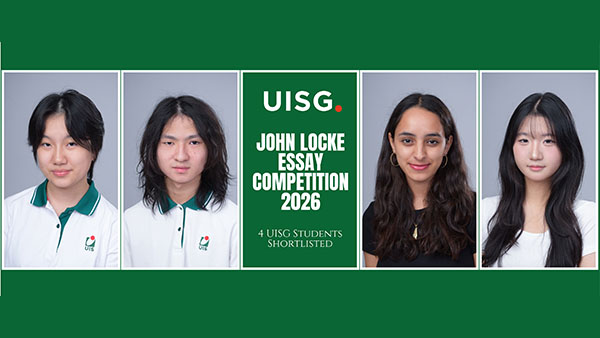
We are incredibly proud to announce that four of our students—Evelyn, Avery, Xarina, and Jimin —have been shortlisted for the prestigious John Locke Institute Global Essay Competition.
Here is a glimpse into their experience and the insights they gained.
01
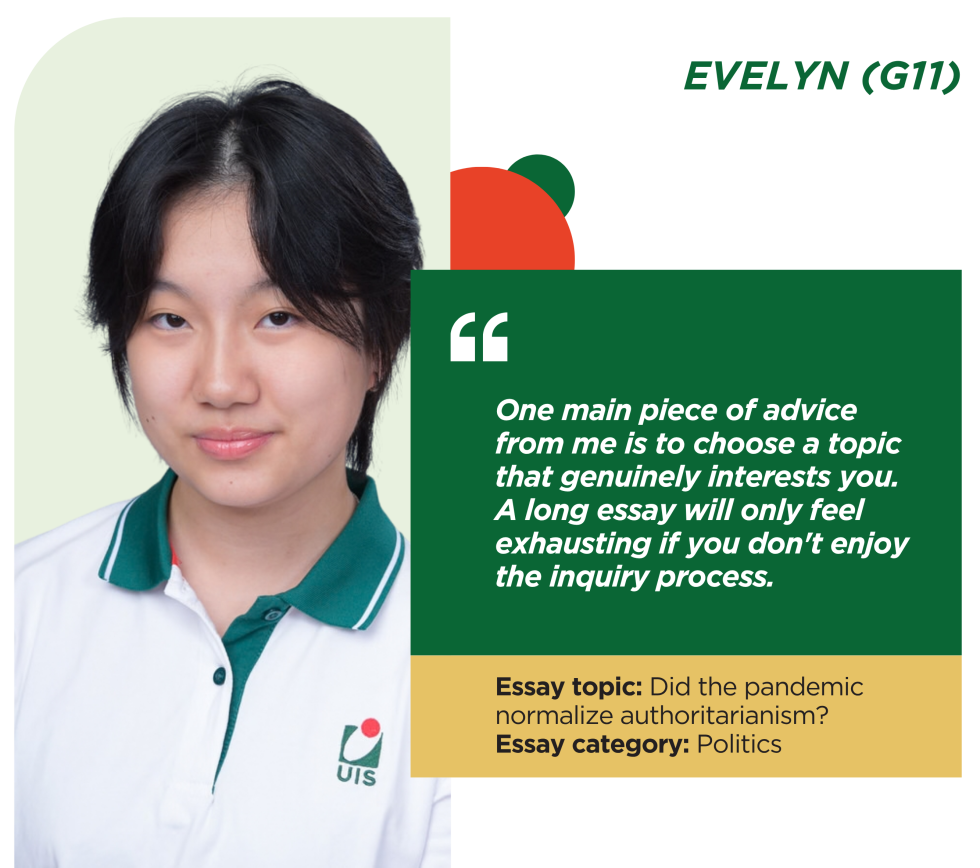
Q1. How was your experience of writing for the competition?
This year was my first time participating in an essay competition, and it was – for me – an experience that felt distinct from the other times where I had to write a long-form essay. Primarily, the stakes felt a lot higher, but in actually researching and writing the essay, I thoroughly enjoyed that process. I especially enjoyed engaging in discussions with my supervising teacher about the question I was responding to. Coming out of this essay, I gained a brand new perspective of what COVID-19 actually looked like, on top of more knowledge in political philosophy from notable figures such as Michel Foucault. Overall, it was gratifying to know that my essay got shortlisted, as I enjoyed working on it very much.
Q2. How did studying at UISG help you prepare for this competition?
I believe studying at UISG – specifically 5 years of the MYP programme – helped me develop the foundational research skills I needed for this essay. On top of that, I had teachers that were extremely helpful in the process who provided me with food for thought, allowing me to refine my arguments and develop a good essay.
Q3. Do you have tips or advice for anybody who does this in the future?
One main piece of advice from me is to choose a topic that genuinely interests you. A long essay will only feel exhausting if you don’t enjoy the inquiry process. Plus, the competition provides 10 categories to choose from, so there should be at least one that spikes your curiosity.
02
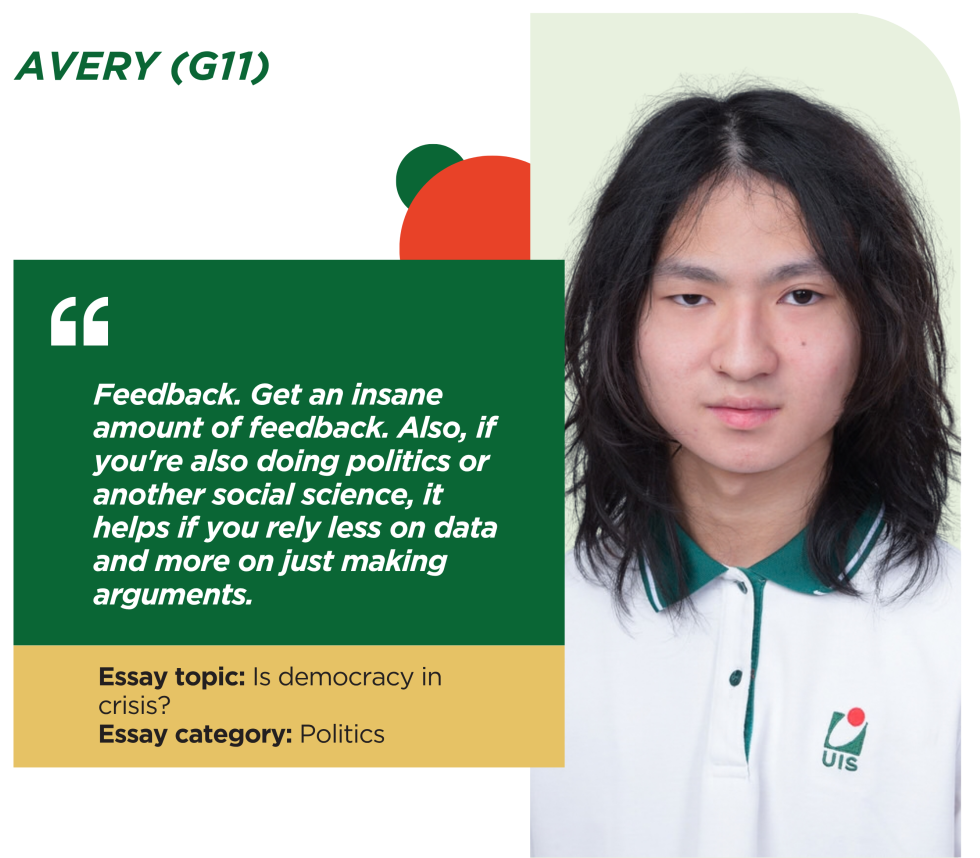
Q1. How was your experience of writing for the competition?
Fun, intensive and maybe a little nerve-racking. It was a lot of sifting through Google, planning out my essay and doing quality-control on my arguments. I’m glad we were basically already done for the year when I started, because otherwise I would absolutely have given up at some point, or paid the $100 for a three-week extension. It was hard to choose just one question as my focus at first; everything was so interesting I just couldn’t decide, but once I did, I got into the groove fast. I wrote the essay over the course of about two weeks. I also got a lot of feedback from my teachers, since it was my first time doing a serious essay competition, and I wanted to get it right. It was like being in G9 all over again.
Q2. How did studying at UISG help you prepare for this competition?
Since I chose to write my essay about politics, of course some of the skills I learned last year and the year before in MYP Individuals & Societies helped massively. This competition was, in some ways, like writing an essay for I&S, really. I had to do the same amount of research, planning and organization (and bugging my teachers) that I would normally do for any essay at school. It felt sort of like an opportunity to take some of the things I’ve learned in school and put it to use, in a weird way.
Q3. Do you have tips or advice for anybody who does this in the future?
Feedback. Get an insane amount of feedback. Unless you’re a god at writing essays (and, let’s be honest, nobody is), you need another person to look over your stuff, point things out and tell you what you could change or do better. Also, if you’re also doing politics or another social science, it helps if you rely less on data and more on just making arguments. Obviously you need research to back up your points and act as evidence, but if you have an in-text citation every other sentence, or if you’re analyzing graphs, you’re probably doing something wrong. The goal is to write an argumentative essay in response to a question, so keep that in mind while working on your submission.
03
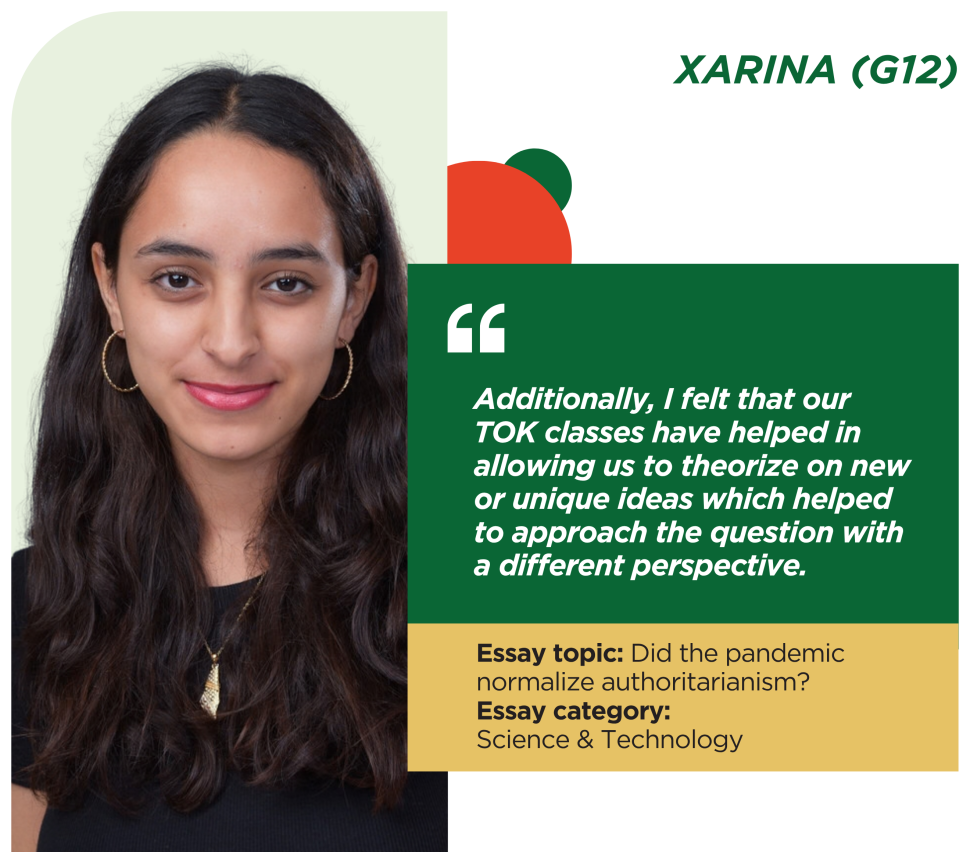
Q1. How was your experience of writing for the competition?
My experience was very fun and non-stressful knowing that there was not much pressure. Since I have already done it once before, I felt like I understood the structure and formatting for what they wanted to see and I was excited to research on the topic. I participated because they just added the new category of Science and Technology which I am really interested in.
Q2. How did studying at UISG help you prepare for this competition?
Doing essays such as my EE and IAs for different classes helped me with the research for this competition. Additionally, I felt that our TOK classes have helped in allowing us to theorize on new or unique ideas which helped to approach the question with a different perspective.
Q3. Do you have tips or advice for anybody who does this in the future?
My biggest advice would be to choose the prompt that you are most interested in. Not the one that seems the easiest or the best option to answer. Go for a prompt that you can explore in different ways and discuss with passion for 2000 words.
04
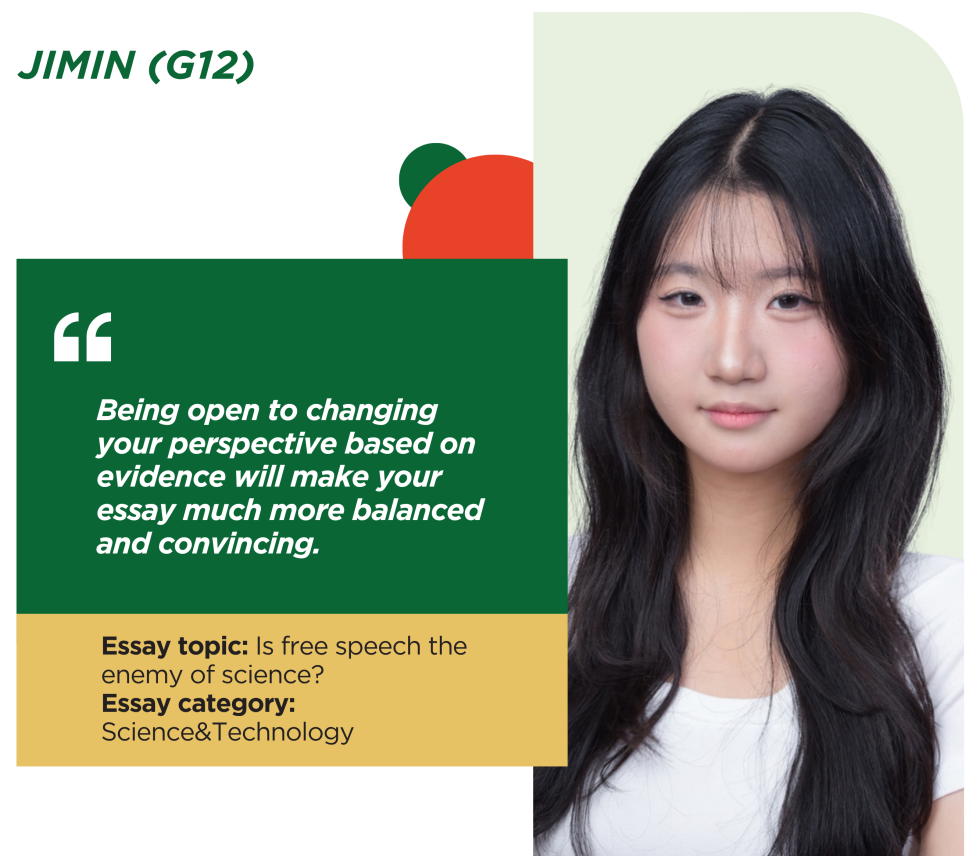
Q1. How was your experience of writing for the competition?
Writing for the competition was challenging, but completing it and seeing the result was very rewarding. When I first looked at the question, it seemed quite simple and easy to answer. However, since students worldwide write essays on the same topic, I wanted to approach it with different perspectives. Through research of historical and contemporary examples, I realized the arguments were much more complex. I enjoyed knowing that different examples can support different perspectives and learning how to make a balanced argument with strong evidence. The experience also helped me to think critically and taught me that strong academic writing is about refining your ideas as you learn more.
Q2. How did studying at UISG help you prepare for this competition?
Studying at UISG prepared me in many ways. Especially, the IB program allowed me to improve my critical thinking and research skills, which are the ATL skills that the teachers have emphasized since MYP. Subjects such as Biology, Economics, and English helped me analyze information by considering different perspectives, and my experience of Internal Assessments and the Extended Essay strengthened my research and academic writing skills. My teachers also encouraged independent thinking, which gave me the confidence to pursue a challenging philosophical question about science.
Q3. Do you have tips or advice for anybody who does this in the future?
One piece of advice is to choose a question that you genuinely find interesting rather than one that sounds impressive. It will make the research process more enjoyable, and your writing will sound more authentic. Additionally, it is important to avoid being too attached to your initial opinion or thought. Instead, try to consider multiple perspectives and research various examples before reaching a conclusion. Some of the strongest parts of my essay also came from considering arguments that challenged my own views. Being open to changing your perspective based on evidence will make your essay much more balanced and convincing.
/ END /

 English
 Chinese
 Korean
 Japanese