



Teacher-to-child ratios in each learning community.
THE MONTESSORI LEGACY
More than a method, a movement
Inspired by Dr. Maria Montessori’s revolutionary work, our approach is built on a profound truth: every child is born with unique potential. Through decades of scientific observation across cultures and communities, Montessori education has grown into a holistic framework that respects the natural development of the child.
Independent education
Cultivating capable, confident learners who say, “I did it myself!”
Peace education
Fostering empathy, respect and global citizenship from the very beginning.

OUR LEARNING COMMUNITIES
Designed for every stage of development
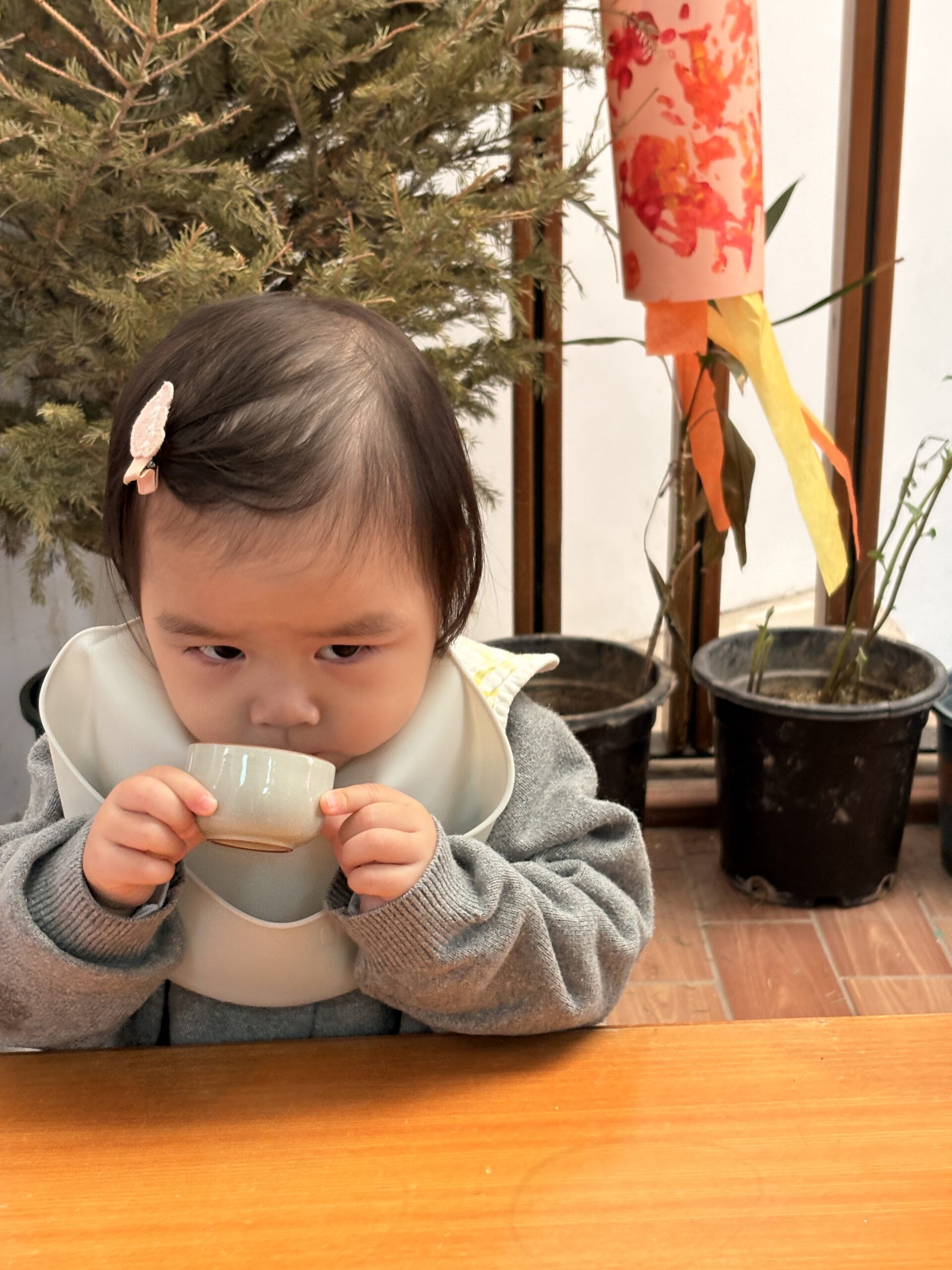
Nido: The Nest
A warm, secure and loving environment where our youngest explorers feel safe to begin discovering the world. Every touch, sound and interaction is a building block for independence.
Options: half-day, full-day and weekend parent-child classes, all designed to support early leaps in sensory awareness, motor skills, language and cognitive growth.

IC: Infant & Toddler Community
As toddlers blossom, they join our vibrant IC community, a prepared environment where life and learning become one. Coordination, language and social skills flourish through purposeful activity.
Children practice skills that last a lifetime: concentration, emotional resilience, problem solving and the joyful confidence of “I did it myself!”

Casa: Children’s House
In our Casa dei Bambini, children aged 3 to 6 learn together in a mixed-age family setting. The curriculum covers five key areas:
- Practical life
- Sensory exploration
- Language (Chinese and English)
- Mathematics
- Science, geography and culture
Foundational academic skills meet real-world understanding, preparing children for a smooth transition to future learning.
TWO APPROACHES TO EARLY LEARNING
How IB Early Years and Montessori differ
Both programs see children as capable and curious. The difference is how inquiry happens, and how it leads into the rest of school.
Inquiry in the IB PYP Early Years
In the PYP, inquiry is the organizing framework for the whole program. It is usually collaborative and built around concepts.
- Learning is organized into transdisciplinary themes and units of inquiry. Early Years programs explore 4 of the 6 themes over the year.
- Play-based learning is the main approach. Children and teachers co-construct learning, and teachers act as co-inquirers.
- Key concepts such as form, function, causation and change, along with the learner profile and approaches to learning, shape the questions children pursue.
- Agency and student voice are explicit goals. Children help shape what gets explored and how.
- Assessment is ongoing, mostly through documentation of learning.
Inquiry in Montessori
Montessori is built on child-led discovery. Children choose their own work, explore at their own pace and find answers through hands-on materials. Here, inquiry is individual and materials-driven.
- Self-correcting materials, like the pink tower or the knobbed cylinders, let a child find and fix errors without an adult stepping in.
- The teacher, or “guide,” observes closely and gives short presentations, often one-on-one, when a child is ready for the next material.
- Learning follows a carefully sequenced set of materials across practical life, sensorial, language, math and cultural studies.
- Children usually have long blocks of uninterrupted work time, typically about three hours.
| Key differences | Montessori | IB PYP Early Years |
|---|---|---|
| Driver of learning | The prepared environment and specialized materials | Children’s questions, framed by units of inquiry |
| Social structure | Mostly individual work | Collaborative, in small and whole groups |
| Teacher role | Observer and guide who presents materials | Co-inquirer and facilitator |
| Curriculum | A fixed developmental sequence of materials | A concept-based framework the school adapts |
| Play | Purposeful “work,” with less emphasis on pretend play | Play is central, including imaginative play |
| Age grouping | Mixed ages, usually 3 to 6 together | Usually grouped by age or grade |
| Technology and design | Hands-on Montessori materials, without technology | Screen-free Tale-Bot Pro coding and early design thinking |
| Accountability | Montessori associations such as AMI | IB authorization and evaluation cycle |
| What comes next | Children move on to a primary program after age 6 | The same IB framework continues through the PYP, MYP and DP |
Where they overlap
Both value hands-on experience, a carefully designed learning environment and the development of the whole child. When your family is ready, children can move from UNC into IB Early Years from age 2 and continue in the IB all the way to Grade 12. Explore IB Early Years →
 English
 Chinese
 Korean
 Japanese